
Uncategorized
The History of Indonesia Through the Ages: From Prehistoric Times to Independence
Nov
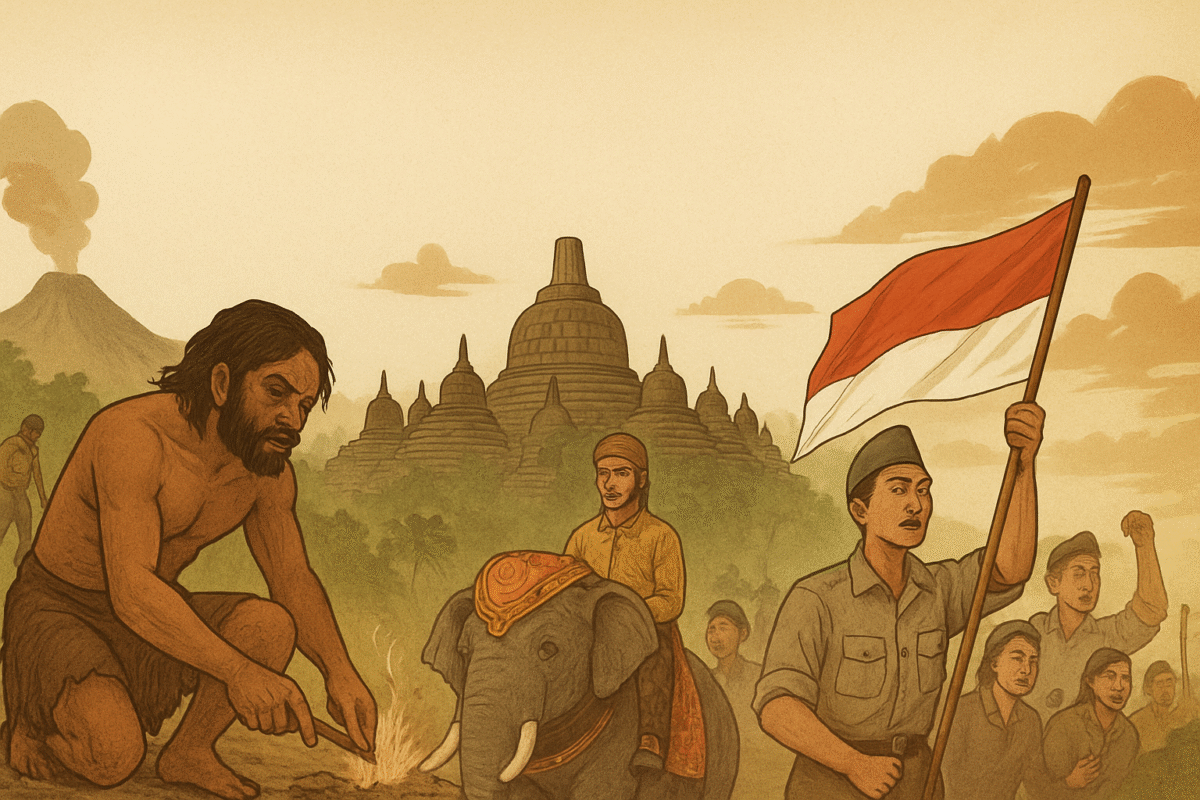
Indonesia is known as a country with a long and rich history. The nation’s journey began in prehistoric times, continued with the rise of powerful kingdoms, the arrival of European colonial powers, and finally, the struggle for independence in 1945. Let’s explore the fascinating history of Indonesia through the ages.
Prehistoric Era in Indonesia
The history of Indonesia begins long before the rise of kingdoms. One of the most significant discoveries is the fossil of Homo Erectus, also known as Java Man, found in Sangiran, Central Java. These fossils are estimated to be around 1.5 million years old.
Another remarkable discovery is Homo Floresiensis, unearthed in Liang Bua, Flores, East Nusa Tenggara. These findings prove that the Indonesian archipelago has been inhabited by early humans for millions of years, making it an important part of human civilization.
Ancient Kingdoms of Indonesia
After the prehistoric era, Indonesia’s history flourished with the rise of powerful kingdoms that shaped the nation’s cultural and political landscape.
- The Sriwijaya Kingdom
Based in South Sumatra, the maritime Sriwijaya Kingdom ruled from the 7th to the 13th century. It dominated important trade routes across Sumatra and the Malacca Strait while also serving as a major center of Buddhism in Southeast Asia.
- The Mataram Kingdom
In the 8th century, under the Syailendra Dynasty, the Mataram Kingdom built Borobudur Temple, the largest Buddhist monument in the world, which still stands proudly today.
- The Majapahit Kingdom
Located in East Java, the Majapahit Kingdom is considered one of the greatest empires in Indonesian history. Majapahit managed to unify large parts of the archipelago and is often regarded as the foundation of the modern Indonesian nation.
Alongside these great empires, numerous Islamic sultanates also emerged from the 13th century onwards, including the Sultanates of Demak, Ternate, and Tidore.
The Colonial Era in Indonesia
Indonesia entered a new era when European powers arrived in search of spices. Following Marco Polo’s journey to Sumatra, the Portuguese, Spanish, Dutch, and British competed for control of the archipelago.
In 1596, the first Dutch ship landed on the coast of West Java. From that moment, the Dutch established their rule and colonized Indonesia for more than 350 years. While this period brought great suffering, it also sparked a growing spirit of resistance among Indonesians.
The Struggle for Independence
The nationalist movement gained momentum in the early 20th century. A key milestone was the Youth Pledge (Sumpah Pemuda) in 1928, where young Indonesians declared their unity: one motherland, one nation, and one language—Indonesia.
After Japan’s defeat in World War II, Indonesia seized the opportunity. On August 17, 1945, Soekarno and Mohammad Hatta proclaimed Indonesia’s independence. Although the Dutch attempted to reassert control, after years of conflict they officially recognized Indonesia’s sovereignty in 1950.
Conclusion
The history of Indonesia stretches from prehistoric times to the struggle for independence. From ancient human fossils, glorious kingdoms, and centuries of colonial rule, to finally achieving freedom—Indonesia’s story is one of resilience and strength.
Understanding Indonesian history is not only fascinating but also essential in appreciating the nation’s identity and heritage.
